
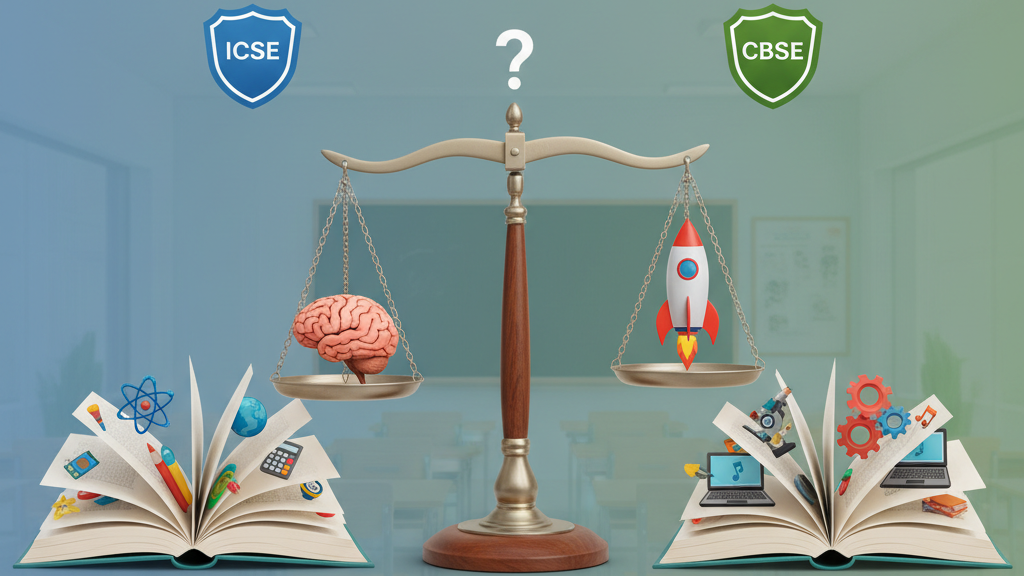
ICSE vs CBSE: Which Curriculum is Better for Your Child’s Future?
Meta Description: Confused between ICSE and CBSE? Discover the key differences in curriculum, teaching methods, and global recognition to help you choose the best board for your child’s success.
Introduction to ICSE and CBSE
Choosing the right educational board is one of the most important decisions parents make for their child’s academic future. In India, two of the most widely recognized boards are ICSE (Indian Certificate of Secondary Education) and CBSE (Central Board of Secondary Education). Both have distinct advantages, and the best choice depends on your child’s learning style, strengths, and long-term goals.
At Sacred Heart School Siliguri, an ICSE-affiliated institution, students benefit from a holistic, enquiry-based curriculum that nurtures critical thinking and creativity. But how does ICSE compare to CBSE? Let’s explore the key differences to help you make an informed decision.
Key Differences Between ICSE and CBSE
1. Curriculum Structure and Focus
- ICSE: Offers a broader, more detailed syllabus with equal emphasis on languages, sciences, and humanities. The curriculum encourages analytical thinking and application-based learning.
- CBSE: Follows a more structured and concise syllabus, focusing on core subjects like Mathematics and Science. The approach is standardised and exam-centric, ideal for competitive exams like JEE and NEET.
2. Examination and Evaluation Patterns
- ICSE: Conducts comprehensive assessments with both internal and external evaluations, including practicals and projects. This system tests conceptual understanding rather than rote memorization.
- CBSE: Uses a more exam-oriented approach, with greater weightage on final board exams. The marking scheme is straightforward, making it easier to score high marks.
3. Medium of Instruction and Language Emphasis
- ICSE: Strong focus on English language proficiency, with compulsory study of a second language. Ideal for students who wish to excel in global education or literature-based careers.
- CBSE: Offers more flexibility, allowing students to study in English, Hindi, or regional languages. The board emphasizes functional language skills over literary depth.
4. Recognition and Global Acceptance
- ICSE: Highly regarded by international universities, especially in the UK, US, and Commonwealth countries, due to its rigorous English-medium curriculum.
- CBSE: Widely accepted in India and preferred for engineering and medical entrance tests. Recognized globally but may require additional coursework for foreign admissions.
Which Curriculum is More Challenging?
The ICSE board is often considered more challenging due to its detailed syllabus and emphasis on writing skills. Students must excel in multiple subjects, including literature, making it ideal for those who thrive in a diverse academic environment.
On the other hand, CBSE is more manageable for students who prefer structured learning and direct exam preparation, especially for IIT-JEE, NEET, and other national-level tests.
Pros and Cons of ICSE
Pros:
- Holistic, well-rounded education
- Strong focus on English and creativity
- Recognized globally for higher studies
- Encourages research and project work
Cons:
- Syllabus can be more extensive
- Less direct focus on engineering/medical entrance exams
Pros and Cons of CBSE
Pros:
- Streamlined syllabus for competitive exams
- Easier scoring system
- Larger number of affiliated schools across India
Cons:
- Less emphasis on language and literature
- Limited scope for non-science students
How to Choose the Right Board for Your Child
Selecting between ICSE and CBSE depends on:
- Career Goals: If your child aims for international education or humanities, ICSE is a better fit. For engineering/medical aspirants, CBSE may be more aligned.
- Learning Style: ICSE suits students who enjoy in-depth learning, while CBSE is ideal for exam-focused learners.
- School Environment: Consider the teaching methodology of the school—like Sacred Heart Siliguri, which blends ICSE’s academic rigor with real-world readiness.
FAQs About ICSE and CBSE Boards
Q: Is ICSE tougher than CBSE?
A: ICSE has a broader syllabus, while CBSE is more exam-focused. Difficulty depends on a student’s learning style.
Q: Which board is better for the USA/UK?
A: ICSE is more widely accepted abroad due to its English proficiency standards.
Q: Can CBSE students switch to ICSE later?
A: Yes, but they may need extra preparation due to syllabus differences.
Conclusion: Making an Informed Choice
Both ICSE and CBSE have unique strengths, and the best choice depends on your child’s aspirations. At Sacred Heart School Siliguri, the ICSE curriculum ensures that students receive a balanced, globally relevant education that prepares them for both higher studies and life beyond academics.
If you’re looking for a nurturing, intellectually stimulating environment in Siliguri, North Bengal, or nearby regions like Nepal, Sikkim, and Bihar, Sacred Heart provides the perfect blend of academic excellence and holistic growth.
Still confused? Visit our campus to see how we shape future-ready learners!
Keywords used naturally: ICSE vs CBSE, best curriculum for child, difference between ICSE and CBSE, ICSE board advantages, CBSE board benefits, choosing school curriculum, Indian education boards, ICSE vs CBSE syllabus